hello
i have talked about my favourite neuro learning resources before
here is an update
do add your suggestions / opinions
_ _ _
1) neurological exam made easy by geraint fuller
great book - short, readable, nice pictures, clinical
2) neurological differential diagnosis by john patten
brilliant book - the best anatomical drawings of neurology (done by the author), clinical, practical
not so short, but all you will ever need to know about neurological examination (unless you become a neurologist)
3) neuroanatomy through clinical cases by hal blumenfeld
great book - very sensible way to learn neuroanatomy, lots of cases, good pictures, associated website
not short, but very readable
4) neuroanatomy: draw it to know it by adam fisch
great book - teaches anatomy by way of staged diagrams illustrating all the major neuro systems
good text too
not short, but nicely 'chunked'
5) neurologic examination website by university of utah
excellent website - videos of normal & abnormal findings for all major components of neuro exam, downloadable (with permission)
6) the neurological exam website by university of toronto
good site - not as comprehensive as utah site, but well laid out with nice tables
videos only with healthy volunteers
7 eyevideos.blogspot.com
good site made by a young ophthalmologist with videos detailing neuro-ophthalmology examination & investigations
Salaam
s
Showing posts with label neurology. Show all posts
Showing posts with label neurology. Show all posts
Tuesday, 14 December 2010

a 20-year-old woman with slurred speech and weakness
yesterday we briefly examined a very pleasant university student who has been unwell since earlier this year
she was alert - we did not test her higher order cognitive function
she had obvious slurring of her speech, which had been present for a month or so
we concentrated on examining her arms
we talked (again) about the importance of INSPECTION
fasciculations can be quite hard to see, especially if the light is poor and the muscles involved are small, so really have a good look - make sure you turn the lights on & adequately expose the patient (which can be done comfortably and with dignity)
_ _ _
as an aside, i wanted to mention motor neurone disease - i know very little about this condition; it results in upper and lower motor neurone signs; it must be one of the worst diseases and there are no treatments, riluzole, the only drug available increases life expectancy by a few months at best (miller et al, 2007);
here is link to a video of the historian tony judt talking about the disease
he died in august
_ _ _
we went on to test tone and then power
this is often done quite badly
my most useful tip (after practise a lot) would be to slow down & think about what you are doing
use the MRC grading scale
if a patient uses their muscles to move their arm (or leg) into the correct position against gravity, then they have already scored 3/5
_ _ _
here is a link to another website showing you how to do a neuro exam
i particularly like the muscle action & innervation chart in the motor section

_ _ _
we talked about the decreased utility of testing for inco-ordination in the context of muscle weakness
_ _ _
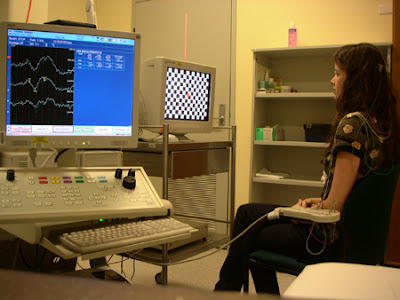
this lady has a diagnosis of multiple sclerosis
she has had several clinical events and has had a full diagnostic work up including MRIs, LP, VEP
the visual evoked potential involves being shown a visual stimulus, eg a pattern, and then measuring electrical responses primarily from the occipital lobe using EEG
[why the occipital lobe?]
she was alert - we did not test her higher order cognitive function
she had obvious slurring of her speech, which had been present for a month or so
we concentrated on examining her arms
we talked (again) about the importance of INSPECTION
fasciculations can be quite hard to see, especially if the light is poor and the muscles involved are small, so really have a good look - make sure you turn the lights on & adequately expose the patient (which can be done comfortably and with dignity)
_ _ _
as an aside, i wanted to mention motor neurone disease - i know very little about this condition; it results in upper and lower motor neurone signs; it must be one of the worst diseases and there are no treatments, riluzole, the only drug available increases life expectancy by a few months at best (miller et al, 2007);
here is link to a video of the historian tony judt talking about the disease
he died in august
_ _ _
we went on to test tone and then power
this is often done quite badly
my most useful tip (after practise a lot) would be to slow down & think about what you are doing
use the MRC grading scale
if a patient uses their muscles to move their arm (or leg) into the correct position against gravity, then they have already scored 3/5
_ _ _
here is a link to another website showing you how to do a neuro exam
i particularly like the muscle action & innervation chart in the motor section

we talked about the decreased utility of testing for inco-ordination in the context of muscle weakness
_ _ _
this lady has a diagnosis of multiple sclerosis
she has had several clinical events and has had a full diagnostic work up including MRIs, LP, VEP
the visual evoked potential involves being shown a visual stimulus, eg a pattern, and then measuring electrical responses primarily from the occipital lobe using EEG
[why the occipital lobe?]

_ _ _
she was actually admitted for episodes of loss of consciousness, the cause of which is not entirely clear
interestingly she is due to have a tilt table test - i mentioned my ignorance of the effects of MS on the autonomic nervous system
she is in the midst of a relapse affecting her speech, face, right arm & leg, and is due to start steroids this week
Salaam
Wednesday, 8 December 2010
a 48-year-old woman with breathlessness and difficulty walking
on monday we saw a very pleasant middle-aged woman, a pretty heavy smoker, with a history of COPD
she had had multiple courses of oral steroids in the past but no previous admissions until last week when she had a short stay for an infective episode
she become breathless enough to significantly restrict her activity around 24 hours post discharge
we focused on examining her so did not talk much about her symptoms
we could have explored possible reasons why she deteriorated
what do you think?
possibilities that spring to my mind are:
- ineffective treatment for respiratory infection (eg resistant organism)
- PE
- pneumothorax
- heart failure
- something else
_ _ _
thanks to our patient's forbearance, we examined her chest & legs (neuro) in detail
thoughts:
- make an effort to really stand at the end of the bed and LOOK:
you can determine asymmetry, depth of breathing, colour, adjuncts and much more; in this case we would have been able to get the diagnosis from just looking without doing anything else
- practise percussing things: in the experience the key is having a very stiff middle finger of the left hand, and a very floppy right wrist; you can percuss lots of things (eg walls to see where joists are, barrels to see how full they are)
- most medical students find neurological examination hard - so you are not alone!
- knowing some neuroanatomy helps, as does giving clear instructions
- i have mentioned my favourite neuro learning resources before
our patient had weakness of left ankle dorsiflexion and a lost left ankle jerk, suggesting an S1 root lesion; her sensory loss was patchy
her leg symptoms are long-standing; we did not look at previous spinal imaging -we should have done!
_ _ _
Salaam
s
she had had multiple courses of oral steroids in the past but no previous admissions until last week when she had a short stay for an infective episode
she become breathless enough to significantly restrict her activity around 24 hours post discharge
we focused on examining her so did not talk much about her symptoms
we could have explored possible reasons why she deteriorated
what do you think?
possibilities that spring to my mind are:
- ineffective treatment for respiratory infection (eg resistant organism)
- PE
- pneumothorax
- heart failure
- something else
_ _ _
thanks to our patient's forbearance, we examined her chest & legs (neuro) in detail
thoughts:
- make an effort to really stand at the end of the bed and LOOK:
you can determine asymmetry, depth of breathing, colour, adjuncts and much more; in this case we would have been able to get the diagnosis from just looking without doing anything else
- practise percussing things: in the experience the key is having a very stiff middle finger of the left hand, and a very floppy right wrist; you can percuss lots of things (eg walls to see where joists are, barrels to see how full they are)
- most medical students find neurological examination hard - so you are not alone!
- knowing some neuroanatomy helps, as does giving clear instructions
- i have mentioned my favourite neuro learning resources before
our patient had weakness of left ankle dorsiflexion and a lost left ankle jerk, suggesting an S1 root lesion; her sensory loss was patchy
her leg symptoms are long-standing; we did not look at previous spinal imaging -we should have done!
_ _ _
Salaam
s
Tuesday, 28 September 2010
a 64 year old man with incoordination
sheena briefly presented the case of a man who fell over at the bus stop
we focused on examining his cerebellar system
we could only examine his left arm
he had:
- no rebound of the outstretched arm
- no dysmetria
- mild dysdiadochokinesis at the forearm
- moderate dysdiadochokinesis at the fingers
- unconvincing horizontal nystagmus in the direction of gaze
- a reasonable gait
- normal heel-toe walking
we did not test his speech
we did test his power (why would we want to do this?)
_ _ _
unfortunately we had to rush his story & did not look at his scans
sheena: could you update us (anonymously) please?
_ _ _
we talked about learning resources
i mentioned the book by geraint fuller which i think is excellent
this site from the university of utah is also excellent & demonstrates many of the signs we were discussing
_ _ _
Salaam
sabih
we focused on examining his cerebellar system
we could only examine his left arm
he had:
- no rebound of the outstretched arm
- no dysmetria
- mild dysdiadochokinesis at the forearm
- moderate dysdiadochokinesis at the fingers
- unconvincing horizontal nystagmus in the direction of gaze
- a reasonable gait
- normal heel-toe walking
we did not test his speech
we did test his power (why would we want to do this?)
_ _ _
unfortunately we had to rush his story & did not look at his scans
sheena: could you update us (anonymously) please?
_ _ _
we talked about learning resources
i mentioned the book by geraint fuller which i think is excellent
this site from the university of utah is also excellent & demonstrates many of the signs we were discussing
_ _ _
Salaam
sabih
Monday, 21 June 2010
neurological examination
this is not easy!
while most of you know the sequence [what was the PALS pneumonic? - TOPCAR??], there are real variations in technique, and without good technique signs are missed
this applies to doctors (like me) not just medical students
the chap we saw was wasted proximally, with low/normal tone & symmetrical weakness 4/5 of hip & knee flexion
he had +++ reflexes at the knee & ankle with upgoing plantars
we did not really test sensation properly - he seemed to have intact JPS
he was wobbly on heel-toe walking & his heel-shin co-ordination was poor, although this may be due to his reduced power
_ _ _
in my non-expert mind this does not fit together neatly!
if he has stiff then this would fit better with a UMN/cord lesion, although the pattern of weakness is not typical
he has a proximal myopathy, but classically reflexes are reduced
i will wait to see what happens!
_ _ _
in the meantime i will try to have a look at one of my favourite textbooks (by john patten)
[this really is a work of art - some incredible drawings]
another very good (short) book is by geraint fuller
2 websites:
1) from the university of utah has a great collection of videos (normal & abnormal)
2) associated with an excellent neuroanatomy book by hal blumenfeld
the link to the karim meeran vodcasts is here
Salaam
sabih
while most of you know the sequence [what was the PALS pneumonic? - TOPCAR??], there are real variations in technique, and without good technique signs are missed
this applies to doctors (like me) not just medical students
the chap we saw was wasted proximally, with low/normal tone & symmetrical weakness 4/5 of hip & knee flexion
he had +++ reflexes at the knee & ankle with upgoing plantars
we did not really test sensation properly - he seemed to have intact JPS
he was wobbly on heel-toe walking & his heel-shin co-ordination was poor, although this may be due to his reduced power
_ _ _
in my non-expert mind this does not fit together neatly!
if he has stiff then this would fit better with a UMN/cord lesion, although the pattern of weakness is not typical
he has a proximal myopathy, but classically reflexes are reduced
i will wait to see what happens!
_ _ _
in the meantime i will try to have a look at one of my favourite textbooks (by john patten)
[this really is a work of art - some incredible drawings]
another very good (short) book is by geraint fuller
2 websites:
1) from the university of utah has a great collection of videos (normal & abnormal)
2) associated with an excellent neuroanatomy book by hal blumenfeld
the link to the karim meeran vodcasts is here
Salaam
sabih
Subscribe to:
Posts (Atom)

 Posts
Posts


